Sunday, September 27, 2015

Millesimal fineness - prototype circuit boards - China printed circuit assemblies


Millesimal fineness – prototype circuit boards – China printed circuit assemblies


Millesimal fineness is a system of denoting the purity of platinum, gold and silver alloys by components per thousand of pure metal by mass in the alloy. For example, an alloy containing 75% gold is denoted as “750”. Many European nations use the percentage hallmark stamps (i.e. ‘585’, ‘750’, and so on) rather than ’14K’, ’18K’, and so forth., which is employed in the United States.


It is an extension of the older carat (karat in North American spelling) method of denoting the purity of gold by fractions of 24, such as “18 carat” for an alloy with 75% (18 components per 24) pure gold by mass.


The millesimal fineness is usually rounded to a three figure number, specifically where used as a hallmark, and the fineness may vary slightly from the standard versions of purity.


The most typical millesimal finenesses utilised for precious metals:


999 (also recognized as 3 nines fine)


995 (what most dealer would get your platinum at if it is one hundred% pure)


950 (the most widespread purity for platinum jewellery)


900 (also recognized as one particular nine fine)


999.99 (The purest sort of Gold in the marketplace)


999 (Fine gold equivalent to 24 carat, also identified as three nines fine)


990 also recognized as two nines fine


916 (equivalent to 22 carat)


833 (equivalent to 20 carat)


750 (equivalent to 18 carat)


625 (equivalent to 15 carat)


585 (equivalent to 14 carat)


417 (equivalent to 10 carat)


375 (equivalent to 9 carat)


333 (equivalent to eight carat minimum standard for gold in Germany soon after 1884)


999.9 (Ultra-fine silver utilized by Royal Canadian Mint in the Canadian Silver Maple Leaf)


999 (Fine silver utilized in bullion bars, also known as 3 nines fine)


980 (widespread common used in Mexico ca.1930 – 1945)


958 (equivalent to Britannia silver)


950 (equivalent to “French 1st Common”)


925 (equivalent to Sterling silver)


900 (equivalent to “Coin silver” in the USA, also recognized as 1 nine fine)


875 (could be located in former USSR and in Switzerland)


833 (widespread standard utilized in continental silver especially among the Dutch, Swedish, and Germans)


830 (widespread standard utilized in older Scandinavian silver)


835 (a regular predominantly utilised in Germany following 1884)


800 (minimum regular for silver in Germany soon after 1884 Egyptian silver Canadian silver circulating coinage)


750 (uncommon silver common located in older German, Swiss and Austro-Hungarian silver)


Gold as an investment


Silver as an investment


Anklet Belt buckle Belly chain Bracelet Brooch Chatelaine Crown Cufflink Earring lapel pin Necklace Pendant Ring Tiara Tie clip Watch (pocket)


Bench jeweler Goldsmith Jewelry designer Lapidary Watchmaker


Casting (centrifugal, lost-wax, vacuum) Enameling Engraving Filigree Metal clay Plating Polishing Repouss and chasing Soldering Stonesetting Wire wrapping


Draw plate File Hammer Mandrel Pliers


Gold Palladium Platinum Rhodium Silver


Britannia silver Colored gold Crown gold Electrum Platinum sterling Shakudo Shibuichi Sterling silver Tumbaga


Brass Bronze Copper Kuromido Pewter Stainless steel Titanium


Aventurine Agate Alexandrite Amethyst Aquamarine Carnelian Citrine Diamond Emerald Garnet Jade Jasper Malachite Lapis lazuli Moonstone Obsidian Onyx Opal Peridot Quartz Ruby Sapphire Sodalite Sunstone Tanzanite Tiger’s Eye Topaz Tourmaline


Amber Copal Coral Jet Pearl Abalone


Carat (unit) Carat (purity) Locating Millesimal fineness


Connected topics: Body piercing Style Gemology Metalworking Wearable art


We are high quality suppliers, our items such as prototype circuit boards , China printed circuit assemblies for oversee purchaser. To know more, please visits gerber pcb.


(Source from China rapid prototype company blog)

Saturday, September 26, 2015

Additive Manufacturing - Precision In A Prototype


Additive Manufacturing – Precision In A Prototype

Back in the day, generating a model or prototype necessary you to start with a chunk of some raw material such as clay, wood, or metal, and to steadily chip away at it until it formed the prototype of your style. This is typically identified as subtractive manufacturing, given that it includes subtracting from the original material to produce your prototype or solution. Additive manufacturing takes a diverse approach – the opposite strategy, in fact. Rather of subtracting layers of supplies, it gradually adds layers where they are required in order to type the prototype. This method is particularly valuable when it comes to metal prototyping.


Additive manufacturing is specifically helpful in the region of metal prototyping for a variety of factors. One of the most distinctive properties of metal is that it is hard. This indicates that a metal prototype will be sturdy and can even be employed in production. But since metal is so difficult, it can also be difficult to reduce into with accuracy to form a model by subtractive manufacturing. In truth, it can be extremely challenging to create an precise model or prototype by this method. It comes with a lot of challenges, and that is why it is hardly ever employed anymore.


By sintering thin layers of powdered metal to one one more, you can steadily add to your prototype until you have a completed model. Additive manufacturing tends to make it much simpler to type metal prototypes with precision. Rather of chipping away at hardened metal, attempting not to do any a lot more harm than essential, metal sintering permits you to bond with each other powdered metal 1 layer at a time. Each layer is only twenty microns thick, so you can attain unparalleled levels of detail in your metal prototyping by making use of this technique. Creating a metal prototype has by no means been less complicated or far more accurate.


It is crucial for metal prototyping to be as accurate as feasible. These metal prototypes are typically utilized as parts in machines, and if they are not built precisely to specifications, they can result in damage to essential machinery. Additive manufacturing permits you to create precise prototypes with no having to manufacture them in bulk before you are sure that the design is just appropriate for what you require. Becoming capable to create a precise metal prototype that you can actually use implies that you will be in a position to attain a style conclusion significantly quicker than you would have been in a position to if you had used less accurate prototypes.


Check out http://www.directedMFG.com for much more data concerning why this business is one of the prime additive manufacturing companies in the planet. As a single of the premier metal prototyping companies, DirectedMFG continues to give its clients with goods and solutions that meet and exceed expectations. Speak to DirectedMFG these days by calling 714-546-1113.


(Source from China rapid prototype company blog)

Friday, September 25, 2015

IMG_1839

A couple of good prototype maker in china images I found:


IMG_1839
prototype maker in china
Image by rose_symotiuk


IMG_1885
prototype maker in china
Image by rose_symotiuk


(Source from China rapid prototype company blog)

Wednesday, September 23, 2015

Significance of Prototyping Services

Importance of Prototyping Services


Product design and improvement is the term that encompasses the development, designing and manufacturing of the solution. The methodologies have changed but the objective is nevertheless the same. The modify of methods has created this field a lot far more reliable and sturdy. For the duration of the emerging days of this market the item designing was carried out via hand created drawing and the prototypes that were generated lacked accuracy.


Even even though they lack accuracy and reliability, the product designing services were really costly and only massive players in the marketplace had been able to avail this service. But with the establishing technology the accuracy and reliability of the generated prototype has enhanced and the expense of availing the service also becomes cheaper. Thus, the new technologies for item prototyping led to the a lot more trustworthy and precise services and at a quite reasonable value.


One of the main benchmarks in the field of Solution Prototyping was the introduction of Rapid Prototyping tools such as Autodesk. The Autodesk computer software helped the designers to generate a digital prototype of the item and test the generated prototype as well. With the improved version of this computer software it even inherits the feature to produce the 3D prototype of the item defining the measurements and functions of each and every portion.


Then with the establishing era of Solution Designing Solutions there came one more main achievement of 3D printing Prototyping. With the aid of this technology the solution can be visualized like a reside solution. The generated prototypes of the product have the identical appear and feel as that of the original item. The 3D Model Printer is utilized to produce the models for the solution making use of the model printers. The item design and style and improvement industries all over the globe have adapted these latest prototyping solutions and those who are still stuck to the old methods are facing a excellent reduction in their clientele.


Unlike the earlier prototyping strategy, these Speedy Prototyping techniques have created the operate less difficult for solution improvement. When handmade designs have been utilised, accuracy element was significantly missing in numerous of the prototypes as a result of which the improvement team used to perform upon the accuracy and they have to work for each building the item as effectively as to eradicate the errors.


These newest prototyping techniques have created it simpler for designers to inherit accuracy in the generated prototype as properly as they can test the prototype also which increases the level of accuracy and make the solution prototype very dependable for designers, client and development team.


WB Engineering was established in fall 2007, since then has been growing year soon after year by growing its capabilities and client base. Our employees involves engineers with varying backgrounds, including Biomedical, Mechanical and Electrical Engineering. With in property capabilities for digital and speedy prototyping making use of the newest and most sought following technology


Locate A lot more Rapid Prototyping Service China Articles


(Source from China rapid prototype company blog)

Tuesday, September 22, 2015

Good China Prototype Organization images

A couple of good china prototype business pictures I located:


Steven F. Udvar-Hazy Center: south hangar panorama, such as B-29 Superfortress “Enola Gay”, Grumman F6F-3 Hellcat, amongst other folks
china prototype company
Image by Chris Devers
See more photographs of this, and the Wikipedia write-up.


Information, quoting from Smithsonian National Air and Space Museum: Steven F. Udvar-Hazy | Boeing B-29 Superfortress &quotEnola Gay&quot:


Boeing’s B-29 Superfortress was the most sophisticated propeller-driven bomber of Planet War II and the 1st bomber to property its crew in pressurized compartments. Despite the fact that developed to fight in the European theater, the B-29 identified its niche on the other side of the globe. In the Pacific, B-29s delivered a assortment of aerial weapons: traditional bombs, incendiary bombs, mines, and two nuclear weapons.


On August six, 1945, this Martin-constructed B-29-45-MO dropped the 1st atomic weapon employed in combat on Hiroshima, Japan. Three days later, Bockscar (on show at the U.S. Air Force Museum close to Dayton, Ohio) dropped a second atomic bomb on Nagasaki, Japan. Enola Gay flew as the advance weather reconnaissance aircraft that day. A third B-29, The Excellent Artiste, flew as an observation aircraft on both missions.


Transferred from the United States Air Force.


Manufacturer:
Boeing Aircraft Co.
Martin Co., Omaha, Nebr.


Date:

1945


Nation of Origin:

United States of America


Dimensions:

All round: 900 x 3020cm, 32580kg, 4300cm (29ft 6 5/16in. x 99ft 1in., 71825.9lb., 141ft 15/16in.)


Materials:

Polished general aluminum finish


Physical Description:

4-engine heavy bomber with semi-monoqoque fuselage and higher-aspect ratio wings. Polished aluminum finish general, regular late-Globe War II Army Air Forces insignia on wings and aft fuselage and serial number on vertical fin 509th Composite Group markings painted in black &quotEnola Gay&quot in black, block letters on reduce left nose.


• • • • •


See a lot more photos of this, and the Wikipedia article.


Information, quoting from Smithsonian National Air and Space Museum: Steven F. Udvar-Hazy | Grumman F6F-3 Hellcat:


The Grumman F6F Hellcat was initially conceived as an sophisticated version of the U.S. Navy’s then existing front-line fighter, the F4F Wildcat (see NASM collection). The Wildcat’s intended replacement, the Vought F4U Corsair (see NASM collection), 1st flown in 1940, was showing wonderful promise, but development was slowed by troubles, including the crash of the prototype.


The National Air and Space Museum’s F6F-three Hellcat, BuNo. 41834, was built at Grumman’s Bethpage, New York, factory in February 1944 below contract NOA-(S)846. It was delivered to the Navy on February 7, and arrived in San Diego, California, on the 18th. It was assigned to Fighter Squadron 15 (VF-15) on USS Hornet (CV12) bound for Hawaii. On arrival, it was assigned to VF-three where it sustained harm in a wheels-up landing at NAS Barbers Point, Hawaii. Following repair, it was assigned to VF-83 where it was utilised in a instruction function till February 21, 1945. After numerous transfers 41834 was converted to an F6F-3K target drone with the installation of sophisticated radio-manage gear. It was painted red with a pink tail that carried the number 14. Its mission was to be employed in Operation Crossroads – the atomic bomb tests at Bikini Atoll. It flew on June 24, 1946, with a pilot, on a practice flight and was launched, unmanned, quickly after the 1st bomb test. Instrumentation on board and photographic plates taped to the handle stick obtained information on radioactivity. Three much more manned flights preceded the final unmanned flight on July 25, 1946, which evaluated the very first underwater explosion. Records indicate that exposure of this aircraft to the radioactive cloud was minimal and residual radiation is negligible.


F6F-3K 41834 was transferred to NAS Norfolk and logged its final flight on March 25, 1947, with a total of 430.2 flying hours. It was assigned to the National Air Museum on November three, 1948, and remained at Norfolk until October 4, 1960, when it was moved by barge to Washington and placed in storage. In 1976 this Hellcat was loaned to the USS Yorktown Museum at Charleston, South Carolina. A superficial restoration was performed at the museum, but because of the harsh environment and its poor condition the Hellcat was returned to NASM on March 16, 1982. In 1983, it was sent to Grumman Aerospace where a group of volunteers entirely restored the aircraft. In 1985, it was shipped back to the Paul E. Garber Preservation, Restoration and Storage Facility in Suitland, Maryland, and put in storage. NASM’s F6F-3 Hellcat is scheduled to be displayed in the new Steven F. Udvar-Hazy center at Dulles International Airport in Virginia in 2004.


Transferred from the United States Navy.


Manufacturer:
Grumman Aircraft Engineering Corporation


Date:

1943


Country of Origin:

United States of America


Dimensions:

Overall: 338 x 1021cm, 4092kg, 1304cm (11ft 1 1/16in. x 33ft 5 15/16in., 9021.2lb., 42ft 9 3/8in.)


Physical Description:

Heavy armor plate, reinforced empennage, R-2800-10W engine, spring tabs on the ailerons (increased maneuverability), could carry rockets as well as bombs.


(Source from China rapid prototype company blog)

Monday, September 21, 2015

Cool China Prototype Company pictures

A handful of good china prototype company pictures I located:


Steven F. Udvar-Hazy Center: Boeing B-29 Superfortress “Enola Gay” (front starboard view), with Grumman F6F-three Hellcat at back-proper, among other folks
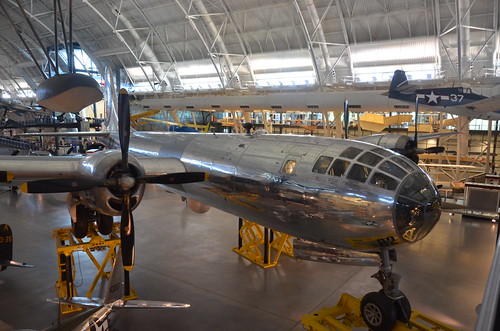
china prototype company
Image by Chris Devers
See more pictures of this, and the Wikipedia report.


Particulars, quoting from Smithsonian National Air and Space Museum: Steven F. Udvar-Hazy | Boeing B-29 Superfortress &quotEnola Gay&quot:


Boeing’s B-29 Superfortress was the most sophisticated propeller-driven bomber of World War II and the 1st bomber to home its crew in pressurized compartments. Though made to fight in the European theater, the B-29 discovered its niche on the other side of the globe. In the Pacific, B-29s delivered a variety of aerial weapons: traditional bombs, incendiary bombs, mines, and two nuclear weapons.


On August six, 1945, this Martin-constructed B-29-45-MO dropped the 1st atomic weapon utilized in combat on Hiroshima, Japan. Three days later, Bockscar (on display at the U.S. Air Force Museum near Dayton, Ohio) dropped a second atomic bomb on Nagasaki, Japan. Enola Gay flew as the advance climate reconnaissance aircraft that day. A third B-29, The Great Artiste, flew as an observation aircraft on both missions.


Transferred from the United States Air Force.


Manufacturer:
Boeing Aircraft Co.
Martin Co., Omaha, Nebr.


Date:

1945


Country of Origin:

United States of America


Dimensions:

General: 900 x 3020cm, 32580kg, 4300cm (29ft six five/16in. x 99ft 1in., 71825.9lb., 141ft 15/16in.)


Supplies:

Polished general aluminum finish


Physical Description:

Four-engine heavy bomber with semi-monoqoque fuselage and high-aspect ratio wings. Polished aluminum finish general, normal late-Globe War II Army Air Forces insignia on wings and aft fuselage and serial quantity on vertical fin 509th Composite Group markings painted in black &quotEnola Gay&quot in black, block letters on lower left nose.


• • • • •


Quoting Smithsonian National Air and Space Museum | Grumman F6F-3 Hellcat:


The Grumman F6F Hellcat was originally conceived as an advanced version of the U.S. Navy’s then present front-line fighter, the F4F Wildcat (see NASM collection). The Wildcat’s intended replacement, the Vought F4U Corsair (see NASM collection), first flown in 1940, was displaying excellent promise, but development was slowed by difficulties, such as the crash of the prototype.


The National Air and Space Museum’s F6F-three Hellcat, BuNo. 41834, was built at Grumman’s Bethpage, New York, factory in February 1944 under contract NOA-(S)846. It was delivered to the Navy on February 7, and arrived in San Diego, California, on the 18th. It was assigned to Fighter Squadron 15 (VF-15) on USS Hornet (CV12) bound for Hawaii. On arrival, it was assigned to VF-three exactly where it sustained harm in a wheels-up landing at NAS Barbers Point, Hawaii. After repair, it was assigned to VF-83 where it was used in a coaching role till February 21, 1945. Right after many transfers 41834 was converted to an F6F-3K target drone with the installation of sophisticated radio-handle gear. It was painted red with a pink tail that carried the quantity 14. Its mission was to be utilized in Operation Crossroads – the atomic bomb tests at Bikini Atoll. It flew on June 24, 1946, with a pilot, on a practice flight and was launched, unmanned, soon soon after the initial bomb test. Instrumentation on board and photographic plates taped to the handle stick obtained information on radioactivity. Three much more manned flights preceded the final unmanned flight on July 25, 1946, which evaluated the 1st underwater explosion. Records indicate that exposure of this aircraft to the radioactive cloud was minimal and residual radiation is negligible.


F6F-3K 41834 was transferred to NAS Norfolk and logged its final flight on March 25, 1947, with a total of 430.2 flying hours. It was assigned to the National Air Museum on November 3, 1948, and remained at Norfolk until October 4, 1960, when it was moved by barge to Washington and placed in storage. In 1976 this Hellcat was loaned to the USS Yorktown Museum at Charleston, South Carolina. A superficial restoration was performed at the museum, but simply because of the harsh environment and its poor condition the Hellcat was returned to NASM on March 16, 1982. In 1983, it was sent to Grumman Aerospace where a group of volunteers completely restored the aircraft. In 1985, it was shipped back to the Paul E. Garber Preservation, Restoration and Storage Facility in Suitland, Maryland, and put in storage. NASM’s F6F-3 Hellcat is scheduled to be displayed in the new Steven F. Udvar-Hazy center at Dulles International Airport in Virginia in 2004.


Transferred from the United States Navy.


Manufacturer:
Grumman Aircraft Engineering Corporation


Date:

1943


Nation of Origin:

United States of America


Dimensions:

All round: 338 x 1021cm, 4092kg, 1304cm (11ft 1 1/16in. x 33ft five 15/16in., 9021.2lb., 42ft 9 3/8in.)


Physical Description:

Heavy armor plate, reinforced empennage, R-2800-10W engine, spring tabs on the ailerons (elevated maneuverability), could carry rockets as well as bombs.


Steven F. Udvar-Hazy Center: Yellow Northrop N1M flying wing airplane, in front of Northrop P-61C Black Widow and tail of the Boeing B-29 Superfortress “Enola Gay”, et al
china prototype company
Image by Chris Devers
See a lot more pictures of this, and the Wikipedia article.


Details, quoting from Smithsonian National Air and Space Museum: Steven F. Udvar-Hazy | Northrop N1M:


John K. &quotJack&quot Northrop’s dream of a flying wing became a reality on July 3, 1940, when his N-1M (Northrop Model 1 Mockup) first flew. 1 of the world’s preeminent aircraft designers and creator of the Lockheed Vega and Northrop Alpha, Northrop had experimented with flying wings for over a decade, believing they would have much less drag and higher efficiency than traditional designs. His 1929 flying wing, while effective, had twin tail booms and a standard tail. In the N-1M he developed a correct flying wing.


Built of plywood about a tubular steel frame, the N-1M was powered by two 65-horsepower Lycoming engines, later replaced with two 120-horsepower Franklins. While its flying characteristics had been marginal, the N-1M led to other designs, including the Northrop XB-35 and YB-49 strategic bombers and in the end the B-two stealth bomber.


Transferred from the United States Air Force.


Manufacturer:
Northrop Aircraft Inc.


Date:

1940


Country of Origin:

United States of America


Dimensions:

Wingspan: 11.6 m (38 ft)

Length: five.2 m (17 ft)

Height: 1.5 m (five ft)

Weight, gross: 1,814 kg (four,000 lb)

Top speed: 322 km/h (200 mph)

Engine: two Franklin 6AC264F2, 120 hp

General: 72in. (182.9cm)

Other: 72 x 204 x 456in. (182.9 x 518.two x 1158.2cm)


Supplies:

General: Plywood


Physical Description:

Twin engine flying wing: Wood, painted yellow.


Extended Description:

The N-1M (Northrop Model 1 Mockup) Flying Wing was a natural outgrowth of John K. &quotJack&quot Northrop’s lifelong concern for an aerodynamically clean design and style in which all unnecessary drag caused by protruding engine nacelles, fuselage, and vertical and horizontal tail surfaces would be eliminated. Created in 1939 and 1940, the N-1lM was the 1st pure all-wing airplane to be created in the United States. Its design was the forerunner of the larger all-wing XB-35 and YB-49 bomber! reconnaissance prototypes that Northrop hoped would win Air Force production contracts and eventually change the shape of modern aircraft.


After serving apprenticeships with the Lockheed brothers and Donald Douglas in the early 1920s and designing the hugely productive and revolutionary Lockheed Vega in 1927, Northrop in the late 192Os turned his focus to all-wing aircraft. In 1928, he left the employ of Lockheed and organized the Avion Corporation a year later he developed his initial flying wing, which incorporated such revolutionary features as all-metal, multicellular wing and stressed-skin building. Though the 1929 flying wing was not a correct all-wing design due to the fact it produced use of external manage surfaces and outrigger tail booms, it paved the way for the later N-1 M, which proved the fundamental soundness of Northrop’s thought for an all-wing aircraft. At the time, nevertheless, Northrop did not have the cash to continue building the all-wing thought.


In 1939, Northrop formed his personal aircraft business, Northrop Aircraft, Inc., and as a result was in a position to finance research and development of the N-1M. For help in designing the aircraft, Northrop enlisted the not aerodynamicist Dr. Theodore von Karman, who was at the time Director of the Guggenheim Aeronautical Laboratory at the California Institute Technology, and von Karman’s assistant, Dr. William R. Sears. Walter J. Cerny, Northrop’s assistant design chief, became the general supervisor for the project. To establish the flight characteristics of an all-wing design and style, Northrop Cerny conducted substantial wind tunnel tests or flying wing models. Eventually, the design of the N-1 M benefited from the new low-drag, increase stability NACA airfoils as nicely as enhanced flaps spoilers, and other aerodynamic devices.


Soon after a period of a year, the N-1M, nicknamed the &quotJeep,&quot emerged in July 1940 as a boomerang-shaped flying scale mockup constructed 01 wood and tubular steel with a wingspan of 38 feet a length of 17 feet, and a height of five feet. Pitch and roll manage was accomplished by signifies of elevons on the trailing edge of the wing, which served the function of both elevator and aileron the place of the standard rudder was a split flap device on the wing suggestions these have been initially drooped downward for what was believed to be far better directional stability but later straightened.


Controlled by rudder pedals, the split flaps, or &quotclamshells,&quot could be opened to enhance the angle of glide or decrease airspeed and thus act as air brakes. The center of gravity, wing sweep, arrangement of manage surfaces, and dihedral have been adjustable on the ground. To decrease drag, the aircraft’s two 65-hp Lycoming -145 4-cylinder engines had been buried within the fuselage. These had been later found to be lacking in sufficient power to sustain lift and were replaced by two 120-hp six-cylinder 6AC264F2 air-cooled Franklin engines.


The N-1M produced its 1st test flight on July three, 1940, at Baker Dry Lake, California, with Vance Breese at the controls. Breese’s inaugural flight in the N-1 M was inauspicious. Throughout a higher-speed taxi run, the aircraft hit a rough spot in the dry lake bed, bounced into the air and accidentally became airborne for a couple of hundred yards. In the initial stages of flight testing, Breese reported that the aircraft could fly no higher than five feet off the ground and that flight could only be sustained by maintaining a precise angle of attack. Von Karman was called in and he solved the difficulty by generating adjustments to the trailing edges of the elevons.


When Vance Breese left the N-1 M system to test-fly the North American B-25, Moye Stephens, the Northrop company secretary, took more than testing of the aircraft. By November 1941, following possessing produced some 28 flights, Stephens reported that when attempting to move the N-1M about its vertical axis, the aircraft had a tendency to oscillate in what is referred to as a Dutch roll. That is, the aircraft’s wings alternately rose and fell tracing a circular path in a plane that lies amongst the horizontal and the vertical. Although Stephens was fearful that the oscillations might not be controllable, he discovered that adjustments to the aircraft’s configuration cleared up the dilemma. In Might 1942, Stephens was replaced by John Myers, who served as test pilot on the project for around six months.


Although the exact period of flight testing for the N-1M is difficult to determine due to the fact both Northrop and Army Air Forces records have been lost, we do know that soon after its initial test flight at Baker Dry Lake, the aircraft was flown at Muroc and Rosamond Dry Lake, and at Hawthorne, California, and that late in the testing plan (probably soon after January 1943) it was towed by a C-47 from Muroc to Hawthorne on its final flight with Myers as the pilot.


From its inception, the N-1M was plagued by poor efficiency because it was each overweight and chronically underpowered. In spite of these issues, Northrop convinced General H. H. Hap&quot Arnold that the N-1 M was profitable sufficient to serve as the forerunner of much more advanced flying wing concepts, and the aircraft did type the basis for Northrop’s subsequent improvement of the N-M9 and of the bigger and longer-ranged XB-35 and YB-49 flying wings.


In 1945, Northrop turned the N-1M more than to the Army Air Forces in the hope that it would someday be placed on exhibit. On July 12, 1946, the aircraft was delivered to Freeman Field, Indiana. A little over a month later, the N-1M was provided to the National Air Museum and placed in storage at Park Ridge, Illinois. On Might 1,1949, the aircraft was placed in the Museum’s collection, and a handful of years later moved in packing crates to the Museum’s Preservation, Restoration and Storage Facility in Suitland, Maryland. In 1979, the restoration of the N-1M began, and by early 1983, some four decades after it had made its final flight, the aircraft had been returned to its original situation.


• • • • •


Quoting Smithsonian National Air and Space Museum | Northrop P-61C Black Widow:


The P-61 Black Widow was the initial U.S. aircraft developed to find and destroy enemy aircraft at evening and in negative climate, a feat produced feasible by the use of on-board radar. The prototype 1st flew in 1942. P-61 combat operations started just after D-Day, June 6, 1944, when Black Widows flew deep into German airspace, bombing and strafing trains and road site visitors. Operations in the Pacific began at about the identical time. By the finish of Planet War II, Black Widows had noticed combat in every theater and had destroyed 127 enemy aircraft and 18 German V-1 buzz bombs.


The Museum’s Black Widow, a P-61C-1-NO, was delivered to the Army Air Forces in July 1945. It participated in cold-weather tests, high-altitude drop tests, and in the National Thunderstorm Project, for which the prime turret was removed to make room for thunderstorm monitoring gear.


Transferred from the United States Air Force.


Manufacturer:
Northrop Aircraft Inc.


Date:

1943


Country of Origin:

United States of America


Dimensions:

Overall: 450 x 1500cm, 10637kg, 2000cm (14ft 9 3/16in. x 49ft two 9/16in., 23450.3lb., 65ft 7 three/8in.)


• • • • •


Quoting Smithsonian National Air and Space Museum | Boeing B-29 Superfortress &quotEnola Gay&quot:


Boeing’s B-29 Superfortress was the most sophisticated propeller-driven bomber of Globe War II and the first bomber to property its crew in pressurized compartments. Though developed to fight in the European theater, the B-29 identified its niche on the other side of the globe. In the Pacific, B-29s delivered a variety of aerial weapons: conventional bombs, incendiary bombs, mines, and two nuclear weapons.


On August 6, 1945, this Martin-built B-29-45-MO dropped the 1st atomic weapon used in combat on Hiroshima, Japan. 3 days later, Bockscar (on show at the U.S. Air Force Museum near Dayton, Ohio) dropped a second atomic bomb on Nagasaki, Japan. Enola Gay flew as the advance weather reconnaissance aircraft that day. A third B-29, The Wonderful Artiste, flew as an observation aircraft on both missions.


Transferred from the United States Air Force.


Manufacturer:
Boeing Aircraft Co.
Martin Co., Omaha, Nebr.


Date:

1945


Country of Origin:

United States of America


Dimensions:

General: 900 x 3020cm, 32580kg, 4300cm (29ft six 5/16in. x 99ft 1in., 71825.9lb., 141ft 15/16in.)


Components:

Polished general aluminum finish


Physical Description:

4-engine heavy bomber with semi-monoqoque fuselage and higher-aspect ratio wings. Polished aluminum finish general, standard late-World War II Army Air Forces insignia on wings and aft fuselage and serial quantity on vertical fin 509th Composite Group markings painted in black &quotEnola Gay&quot in black, block letters on decrease left nose.


(Source from China rapid prototype company blog)

Saturday, September 19, 2015

Why driverless automobiles may possibly by no means come about

Why driverless automobiles may possibly never ever occur

“In one particular well-publicised incident, researchers connected a laptop straight to the controller location network – the system which connects multiple vehicle functions – of a standard automobile, [providing] them complete handle over practically each and every system, as they …
Study more on Telegraph.co.uk


Hipster&#39s Skinny Jeans Are Out And World Patent Advertising&#39s Miller Industrial

&quotThe sector is growing swiftly in Asia whilst declining severely in the United States. Firms in created nations take … These incorporate WPM Study, WPM Patents, WPM Web &amp Apps, WPM Prototyping, WPM Manufacturing, WPM Capital Ventures, WPM Social …
Study far more on GlobeNewswire (press release)


&#39Maker Culture&#39: Why it&#39s a key element for HK startup ecosystem

19 and 20, Maker Space Hong Kong and Cyberport organized the initial China Maker Summit in Hong Kong. The concept of organizing the … “Makers are more from notion to prototype while entrepreneurs are more from prototype to functioning demos and to mass …
Read far more on EJ Insight


(Source from China rapid prototype company blog)

Friday, September 18, 2015

Steven F. Udvar-Hazy Center: South hangar panorama, such as Vought OS2U-three Kingfisher seaplane, B-29 Enola Gay, amongst other people

A couple of nice chinese prototype producers images I located:


Steven F. Udvar-Hazy Center: South hangar panorama, such as Vought OS2U-3 Kingfisher seaplane, B-29 Enola Gay, amongst other people
chinese prototype manufacturers
Image by Chris Devers

Quoting Smithsonian National Air and Space Museum | Vought OS2U-three Kingfisher:


The Kingfisher was the U.S. Navy’s major ship-based, scout and observation aircraft for the duration of World War II. Revolutionary spot welding tactics gave it a smooth, non-buckling fuselage structure. Deflector plate flaps that hung from the wing’s trailing edge and spoiler-augmented ailerons functioned like further flaps to allow slower landing speeds. Most OS2Us operated in the Pacific, where they rescued a lot of downed airmen, like Globe War I ace Eddie Rickenbacker and the crew of his B-17 Flying Fortress.


In March 1942, this airplane was assigned to the battleship USS Indiana. It later underwent a six-month overhaul in California, returned to Pearl Harbor, and rejoined the Indiana in March 1944. Lt. j.g. Rollin M. Batten Jr. was awarded the Navy Cross for producing a daring rescue in this airplane beneath heavy enemy fire on July four, 1944.


Transferred from the United States Navy.


Manufacturer:
Vought-Sikorsky Aircraft Division


Date:

1937


Country of Origin:

United States of America


Dimensions:

All round: 15ft 1 1/8in. x 33ft 9 1/2in., 4122.6lb., 36ft 1 1/16in. (460 x 1030cm, 1870kg, 1100cm)


Components:

Wings covered with fabric aft of the principal spar


Physical Description:

Two-seat monoplane, deflector plate flaps hung from the trailing edge of the wing, ailerons drooped at low airspeeds to function like added flaps, spoilers.


• • • • •


Quoting Smithsonian National Air and Space Museum | Boeing B-29 Superfortress &quotEnola Gay&quot:


Boeing’s B-29 Superfortress was the most sophisticated propeller-driven bomber of Globe War II and the initial bomber to house its crew in pressurized compartments. Although designed to fight in the European theater, the B-29 found its niche on the other side of the globe. In the Pacific, B-29s delivered a assortment of aerial weapons: standard bombs, incendiary bombs, mines, and two nuclear weapons.


On August 6, 1945, this Martin-constructed B-29-45-MO dropped the very first atomic weapon employed in combat on Hiroshima, Japan. Three days later, Bockscar (on show at the U.S. Air Force Museum close to Dayton, Ohio) dropped a second atomic bomb on Nagasaki, Japan. Enola Gay flew as the advance climate reconnaissance aircraft that day. A third B-29, The Fantastic Artiste, flew as an observation aircraft on both missions.


Transferred from the United States Air Force.


Manufacturer:
Boeing Aircraft Co.
Martin Co., Omaha, Nebr.


Date:

1945


Nation of Origin:

United States of America


Dimensions:

Overall: 900 x 3020cm, 32580kg, 4300cm (29ft six 5/16in. x 99ft 1in., 71825.9lb., 141ft 15/16in.)


Supplies:

Polished all round aluminum finish


Physical Description:

4-engine heavy bomber with semi-monoqoque fuselage and high-aspect ratio wings. Polished aluminum finish overall, standard late-Planet War II Army Air Forces insignia on wings and aft fuselage and serial quantity on vertical fin 509th Composite Group markings painted in black &quotEnola Gay&quot in black, block letters on lower left nose.


Steven F. Udvar-Hazy Center: South hangar panorama, like Vought OS2U-3 Kingfisher seaplane, B-29 Enola Gay, amongst other folks
chinese prototype manufacturers
Image by Chris Devers

Quoting Smithsonian National Air and Space Museum | Vought OS2U-three Kingfisher:


The Kingfisher was the U.S. Navy’s primary ship-based, scout and observation aircraft throughout Globe War II. Revolutionary spot welding strategies gave it a smooth, non-buckling fuselage structure. Deflector plate flaps that hung from the wing’s trailing edge and spoiler-augmented ailerons functioned like extra flaps to permit slower landing speeds. Most OS2Us operated in the Pacific, exactly where they rescued a lot of downed airmen, such as Globe War I ace Eddie Rickenbacker and the crew of his B-17 Flying Fortress.


In March 1942, this airplane was assigned to the battleship USS Indiana. It later underwent a six-month overhaul in California, returned to Pearl Harbor, and rejoined the Indiana in March 1944. Lt. j.g. Rollin M. Batten Jr. was awarded the Navy Cross for creating a daring rescue in this airplane below heavy enemy fire on July 4, 1944.


Transferred from the United States Navy.


Manufacturer:
Vought-Sikorsky Aircraft Division


Date:

1937


Nation of Origin:

United States of America


Dimensions:

All round: 15ft 1 1/8in. x 33ft 9 1/2in., 4122.6lb., 36ft 1 1/16in. (460 x 1030cm, 1870kg, 1100cm)


Supplies:

Wings covered with fabric aft of the primary spar


Physical Description:

Two-seat monoplane, deflector plate flaps hung from the trailing edge of the wing, ailerons drooped at low airspeeds to function like added flaps, spoilers.


(Source from China rapid prototype company blog)

Thursday, September 17, 2015

Lastest Prototype Made In China News

Finally, Fusion Requires Little Methods Toward Reality

ITER (pronounced “eater”), which draws scientists and funding from China, the European Union, India, Russia, Japan, South Korea, and the United States, is projected to expense dozens of billions of dollars to produce a operating reactor sometime in the …
Study much more on MIT Technology Assessment


VW made vehicle for China, but did globe&#39s cheapest car vanish?

A new low-cost single-seat automobile, introduced several years through a prototype, was scheduled for release not too long ago China and would have produced the Tata Nano, the not-also-extended ago planet&#39s cheapest car, seem pricey. Produced in Hamburg, Germany, and shown only&nbsp…
Study much more on The Weekly Driver


(Source from China rapid prototype company blog)

A Rapid Look on Speedy Prototyping Services

A Fast Look on Fast Prototyping Solutions


Information is not the only key of good results it is only a component of it. Accomplishment comes by integrating the understanding and its implementation. Prototyping is an integral portion of item design and style and improvement. This the only component of item improvement that calls for lot of focus and difficult perform as all the other succeeding phases are entirely dependent on the prototyping solutions. Numbers of companies across the globe are striving tough to attain good results in the field of engineering.


Numbers of organizations are competing in the race of achieving good results in the field of engineering or item improvement services. Creating your name in the field of solution designing calls for the implementation of its standard portion i.e. Prototyping in a appropriate specialist way.


Prototyping is the term that has undergone some serious adjustments and is becoming far better and much better with time. Earlier when the notion of prototyping came the prototype was defined as the hand produced sample of the product on paper defining the structure of the product. The improvement used to put in lot of tough operate in order make the prototype consistent and precise.


Prototyping methods have now turn out to be significantly much more technical, simple and dependable. Now, hand¬-made drawing is extremely rarely employed for prototyping and these who are employing it are facing some significant drawbacks in their clientele. The approach that is largely utilized is Speedy Prototyping and 3D Prototyping. And the very best parts of improvements in the prototyping methods are there is no increment in cost of prototyping.


 Thus, to sustain in the market place, the business need to have to give its products an additional edge over other people. Now for any client availing the service of Speedy Prototyping the query “What is your solution development approach is?”  Doesn’t matter, instead what matters is “How will be your item soon after manufacturing?”There are quantity of item development businesses in the industry, but there are very handful of who can serve up to the expectation of the consumers.


Rapid Prototyping is amongst the greatest advancement in the field of prototyping, which enables the designers to style a item with a touch of accuracy and perfection that adds refinement to the improvement level of the solution. Numerous organizations all more than the globe are following these prototyping tactics and they are excelling in their function at a wonderful pace. They not only excel in their function, but with the use of most current technologies they can simply fulfill client’s expectation and stand by its satisfaction level.


WB Engineering was established in fall 2007, since then has been increasing year right after year by rising its capabilities and consumer base. Our staff consists of engineers with varying backgrounds, which includes Biomedical, Mechanical and Electrical Engineering. With in house capabilities for digital and speedy prototyping employing the newest and most sought after technology.


(Source from China rapid prototype company blog)

Monday, September 14, 2015

Steven F. Udvar-Hazy Center: P-40 Warhawk & F-four Corsair hanging more than the SR-71 Blackbird, amongst other people

Verify out these chinese prototype manufacturers photos:


Steven F. Udvar-Hazy Center: P-40 Warhawk & F-4 Corsair hanging more than the SR-71 Blackbird, amongst other folks
chinese prototype manufacturers
Image by Chris Devers

Quoting Smithsonian National Air and Space Museum | Curtiss P-40E Warhawk (Kittyhawk IA):


Regardless of whether identified as the Warhawk, Tomahawk, or Kittyhawk, the Curtiss P-40 proved to be a successful, versatile fighter for the duration of the 1st half of World War II. The shark-mouthed Tomahawks that Gen. Claire Chennault’s &quotFlying Tigers&quot flew in China against the Japanese remain among the most well-known airplanes of the war. P-40E pilot Lt. Boyd D. Wagner became the first American ace of Planet War II when he shot down six Japanese aircraft in the Philippines in mid-December 1941.


Curtiss-Wright built this airplane as Model 87-A3 and delivered it to Canada as a Kittyhawk I in 1941. It served till 1946 in No. 111 Squadron, Royal Canadian Air Force. U.S. Air Force personnel at Andrews Air Force Base restored it in 1975 to represent an aircraft of the 75th Fighter Squadron, 23rd Fighter Group, 14th Air Force.


Donated by the Exchange Club in Memory of Kellis Forbes.


Manufacturer:
Curtiss Aircraft Business


Date:

1939


Country of Origin:

United States of America


Dimensions:

General: 330 x 970cm, 2686kg, 1140cm (10ft 9 15/16in. x 31ft 9 7/8in., 5921.6lb., 37ft four 13/16in.)


Materials:

All-metal, semi-monocoque


Physical Description:

Single engine, single seat, fighter aircraft.


• • • • •


See more images of this, and the Wikipedia report.


Information, quoting from Smithsonian National Air and Space Museum | Lockheed SR-71 Blackbird:


No reconnaissance aircraft in history has operated globally in much more hostile airspace or with such complete impunity than the SR-71, the world’s quickest jet-propelled aircraft. The Blackbird’s functionality and operational achievements placed it at the pinnacle of aviation technologies developments throughout the Cold War.


This Blackbird accrued about two,800 hours of flight time throughout 24 years of active service with the U.S. Air Force. On its last flight, March six, 1990, Lt. Col. Ed Yielding and Lt. Col. Joseph Vida set a speed record by flying from Los Angeles to Washington, D.C., in 1 hour, 4 minutes, and 20 seconds, averaging 3,418 kilometers (2,124 miles) per hour. At the flight’s conclusion, they landed at Washington-Dulles International Airport and turned the airplane over to the Smithsonian.


Transferred from the United States Air Force.


Manufacturer:
Lockheed Aircraft Corporation


Designer:
Clarence L. &quotKelly&quot Johnson


Date:

1964


Country of Origin:

United States of America


Dimensions:

Overall: 18ft 5 15/16in. x 55ft 7in. x 107ft 5in., 169998.5lb. (5.638m x 16.942m x 32.741m, 77110.8kg)

Other: 18ft 5 15/16in. x 107ft 5in. x 55ft 7in. (five.638m x 32.741m x 16.942m)


Materials:

Titanium


Physical Description:

Twin-engine, two-seat, supersonic strategic reconnaissance aircraft airframe constructed largley of titanium and its alloys vertical tail fins are constructed of a composite (laminated plastic-kind material) to decrease radar cross-section Pratt and Whitney J58 (JT11D-20B) turbojet engines feature massive inlet shock cones.


• • • • •


Quoting Smithsonian National Air and Space Museum | Vought F4U-1D Corsair :


By V-J Day, September 2, 1945, Corsair pilots had amassed an 11:1 kill ratio against enemy aircraft. The aircraft’s distinctive inverted gull-wing design and style allowed ground clearance for the massive, three-bladed Hamilton Regular Hydromatic propeller, which spanned far more than 4 meters (13 feet). The Pratt and Whitney R-2800 radial engine and Hydromatic propeller was the largest and a single of the most effective engine-propeller combinations ever flown on a fighter aircraft.


Charles Lindbergh flew bombing missions in a Corsair with Marine Air Group 31 against Japanese strongholds in the Pacific in 1944. This airplane is painted in the colors and markings of the Corsair Sun Setter, a Marine close-help fighter assigned to the USS Essex in July 1944.


Transferred from the United States Navy.


Manufacturer:
Vought Aircraft Firm


Date:

1940


Nation of Origin:

United States of America


Dimensions:

Overall: 460 x 1020cm, 4037kg, 1250cm (15ft 1 1/8in. x 33ft 5 9/16in., 8900lb., 41ft 1/8in.)


Materials:

All metal with fabric-covered wings behind the major spar.


Physical Description:

R-2800 radial air-cooled engine with 1,850 horsepower, turned a three-blade Hamilton Standard Hydromatic propeller with solid aluminum blades spanning 13 feet 1 inch wing bent gull-shaped on both sides of the fuselage.


Steven F. Udvar-Hazy Center: F-four Corsair & P-40 Warhawk
chinese prototype manufacturers
Image by Chris Devers

Quoting Smithsonian National Air and Space Museum | Curtiss P-40E Warhawk (Kittyhawk IA):


No matter whether identified as the Warhawk, Tomahawk, or Kittyhawk, the Curtiss P-40 proved to be a successful, versatile fighter in the course of the 1st half of Planet War II. The shark-mouthed Tomahawks that Gen. Claire Chennault’s &quotFlying Tigers&quot flew in China against the Japanese remain amongst the most well-liked airplanes of the war. P-40E pilot Lt. Boyd D. Wagner became the first American ace of Globe War II when he shot down six Japanese aircraft in the Philippines in mid-December 1941.


Curtiss-Wright built this airplane as Model 87-A3 and delivered it to Canada as a Kittyhawk I in 1941. It served until 1946 in No. 111 Squadron, Royal Canadian Air Force. U.S. Air Force personnel at Andrews Air Force Base restored it in 1975 to represent an aircraft of the 75th Fighter Squadron, 23rd Fighter Group, 14th Air Force.


Donated by the Exchange Club in Memory of Kellis Forbes.


Manufacturer:
Curtiss Aircraft Business


Date:

1939


Nation of Origin:

United States of America


Dimensions:

Overall: 330 x 970cm, 2686kg, 1140cm (10ft 9 15/16in. x 31ft 9 7/8in., 5921.6lb., 37ft 4 13/16in.)


Components:

All-metal, semi-monocoque


Physical Description:

Single engine, single seat, fighter aircraft.


• • • • •


Quoting Smithsonian National Air and Space Museum | Vought F4U-1D Corsair:


By V-J Day, September two, 1945, Corsair pilots had amassed an 11:1 kill ratio against enemy aircraft. The aircraft’s distinctive inverted gull-wing design allowed ground clearance for the massive, three-bladed Hamilton Common Hydromatic propeller, which spanned a lot more than four meters (13 feet). The Pratt and Whitney R-2800 radial engine and Hydromatic propeller was the largest and 1 of the most potent engine-propeller combinations ever flown on a fighter aircraft.


Charles Lindbergh flew bombing missions in a Corsair with Marine Air Group 31 against Japanese strongholds in the Pacific in 1944. This airplane is painted in the colors and markings of the Corsair Sun Setter, a Marine close-assistance fighter assigned to the USS Essex in July 1944.


Transferred from the United States Navy.


Manufacturer:
Vought Aircraft Organization


Date:

1940


Nation of Origin:

United States of America


Dimensions:

All round: 460 x 1020cm, 4037kg, 1250cm (15ft 1 1/8in. x 33ft five 9/16in., 8900lb., 41ft 1/8in.)


Components:

All metal with fabric-covered wings behind the major spar.


Physical Description:

R-2800 radial air-cooled engine with 1,850 horsepower, turned a three-blade Hamilton Standard Hydromatic propeller with solid aluminum blades spanning 13 feet 1 inch wing bent gull-shaped on both sides of the fuselage.


(Source from China rapid prototype company blog)

Saturday, September 12, 2015

Prototype PCB: Necessity and Rewards


Prototype PCB: Necessity and Rewards


PCB prototype plays a really critical role in the creation and design and style of PCB (Printed Circuit Boards). The design of the PCB does not rely on single components rather depends on selection of elements which wants experience and testing for numerous occasions. And prototype gives you the opportunity to verify your solution before production. Really, we can say that the design and style depends on indistinct set of necessities. This is created to define the essential functions for the electrical and mechanical items. And the prototype helps to fulfill these wants by giving you a possibility for proving your design and style.


The designers consist of all the required functionalities those can fit in the board. As concerning to the specifications, the board changes its shape. Occasionally it is huge with the extensive specifications. And sometimes it’s tiny with fewer requirements. Again several issues are necessary to make a PCB prototype of production stage. Among them, functionality with reliability is a need to. The complexity and functionality determines the necessary quantity of layers. Some board consists of only two layers as they have significantly less functionality and some have even much more than 32 layers for their complexity and higher functionality. And the size also differs a lot. As the board has to sit perfectly into its preferred technique, it have to be made in the best shape. The tolerance is also a aspect as the layers and copper traces certainly depend on it. Most PCB has a design and style with a tolerance that tends to make the layers and copper traces even far more crucial. As they are created with very tight tolerances, they are produced hugely integrated. And this integrity sometime causes some essential difficulties. So, it must be checked meticulously for the accuracy. The voltage have to be moderate with the application and the signals need to also be clean. Once more, the surface elements need to meet the needed tolerance. And right after contemplating all these respects, the created initial board is referred to as the prototype. These are created for testing. They are mostly produced based on the quantity of testing essential. Following the testing is completed, the production starts with the design and style.


These PCB prototypes are checked in all essential situations as every little thing need to be checked and each dilemma should be solved ahead of the production. Again, the leads and traces are re-measured so that it meets the needed thickness. The VIAS and holes need person programming for each and every board and their generating procedure is also sophisticated. The tolerances and electrical signals are tested even right after the addition of the surface components. When all the components are added and it is produced as the specification, it is finally tested for a number of times for the required outcome. The board need to also be capable to give proper reliability and effectiveness. In this time, the board is tested with no planting it in the atmosphere it is produced for. And all steps are recorded. And when it meets the normal high quality, it is sent for production. But if any incorrect occurs, it is tested once again and sent for additional remedy. Even often the complete design and style is changed for the failure in tests.


The prototype is made by the firms to check their items and inventions before manufacturing. And hence it helps a excellent deal in the improvement of PCB.


Prototype PCB Printed Circuit Boards Speedy Quick Manufacturer. We specialize in PCB prototypes. Full featured Computer boards at great rates. Contact for swift, correct PCB quotes on all your PCB fabrication wants.


Discover A lot more Prototype Producers China Articles


(Source from China rapid prototype company blog)
Thursday, September 10, 2015

Galaxy Note 5 release date, cost, specs: How to get Note 5 in the UK

Galaxy Note 5 release date, cost, specs: How to get Note 5 in the UK

Samsung confirmed the final specification of its newest prototype and showcased it to its clients including international telecom businesses to take pre-orders prior to the launch at the end of July,&quot it claims. This would be unexpected, specially offered …
Study a lot more on Pc Advisor (registration)


Asian Morning Briefing: US Stocks Retreat

Stocks jumped in Asia and Europe following an announcement from China&#39s finance ministry on Tuesday evening that the nation would roll out a “more forceful” fiscal policy to enhance its economy. Japan&#39s Nikkei Stock Average jumped the … Apple showed …
Read a lot more on Wall Street Journal


Abaya caught in 3 rail controversies

And the MRT-3 prototype coach he has been bragging about finally arrived from China – but would not run simply because engineless. Subalterns representing Abaya at Monday&#39s Property of Reps hearing refused to divulge what businesses they had been talking with for&nbsp…
Study much more on Philippine Star


(Source from China rapid prototype company blog)

Monday, September 7, 2015

Action Mold Adds Action Prototype


Action Mold Adds Action Prototype


Action Prototype &amp Action Mold have a history of effectively going the additional mile to service our customer’s wants. We did it last year by bringing on line our 1st Engel 90VV Vertical molding machine and Toshiba EC20 power efficient higher precision mold press’s.


It gives a complete rapid prototype and approach of manufacturing solutions that has been made to receive your products to distinct markets in the ideal possible way. Also, it can collect the best results in the quickest attainable way. Also, we have the capability to offer you service when it comes in high and low volume production when it comes to plastic parts. Likewise, buyers need to know that we are dedicated I making use of energy-saving equipments. Our equipments are also environmentally safe and do not impose any threat to it. We use zero VOC paints in order for people not to have any difficulties when it comes to their wellness.


When it comes to the industries we serve, buyers can have the possibility to know that we have a wide range of services that can supply fantastic help for every person. We can offer you service to defense, automotive, architectural, entertainment and even educational aspect, which is why we have a long-standing list of happy consumers that you can use as a reference for our good quality services. All you need to have to do is to maintain in touch with us if you want to know the prices we supply. We can discuss your item development wants and get a quote in order to back you up effectively.


With our wide range of solutions that can supply you excellent service, rest assured that you are in very good hands. All our consumers can get the opportunity to have the satisfaction that they need to have when it comes to our offerings. Moreover, we provide plastic component design and style for injection molding, which is why it is up to you to truly consider our solutions. Consumers will in no way go wrong when it comes to our services. With the addition of Action Prototype in 2009 we have had fantastic achievement in implementing our full turn key support of plastic component production.


From concept all the way by way of to the packaging. Which is generally referred to as “Cradle to Grave”. We continue to supply far more inventive options to answer our clients manufacturing demands. If you have any projects coming up please let us know if we can assist you in any way. We are pleased to manage all or element of your project. Let us take the head ache out of your provide chain.


We provide great plastic design and style and injection molding in order to help you get the best. With our rapid prototype solutions, expect the greatest outcomes that you want to have.


Connected Speedy Prototype Full Service China Articles


(Source from China rapid prototype company blog)

Creation Technologies Welcomes Cong. Paul Ryan in Wisconsin Facility

Steven F. Udvar-Hazy Center: P-40 Warhawk with “sharktooth” nose
rapid prototype full service china
Image by Chris Devers
See a lot more pictures of this, and the Wikipedia article.


Details, quoting from Smithsonian National Air and Space Museum | Curtiss P-40E Warhawk (Kittyhawk IA):


Regardless of whether recognized as the Warhawk, Tomahawk, or Kittyhawk, the Curtiss P-40 proved to be a effective, versatile fighter for the duration of the initial half of Globe War II. The shark-mouthed Tomahawks that Gen. Claire Chennault’s &quotFlying Tigers&quot flew in China against the Japanese remain amongst the most common airplanes of the war. P-40E pilot Lt. Boyd D. Wagner became the initial American ace of World War II when he shot down six Japanese aircraft in the Philippines in mid-December 1941.


Curtiss-Wright constructed this airplane as Model 87-A3 and delivered it to Canada as a Kittyhawk I in 1941. It served until 1946 in No. 111 Squadron, Royal Canadian Air Force. U.S. Air Force personnel at Andrews Air Force Base restored it in 1975 to represent an aircraft of the 75th Fighter Squadron, 23rd Fighter Group, 14th Air Force.


Donated by the Exchange Club in Memory of Kellis Forbes.


Manufacturer:
Curtiss Aircraft Company


Date:

1939


Country of Origin:

United States of America


Dimensions:

All round: 330 x 970cm, 2686kg, 1140cm (10ft 9 15/16in. x 31ft 9 7/8in., 5921.6lb., 37ft four 13/16in.)


Supplies:

All-metal, semi-monocoque


Physical Description:

Single engine, single seat, fighter aircraft.


Extended Description:

Regardless of whether it was the Tomahawk, Warhawk, or Kittyhawk, the Curtiss P-40 was a profitable and versatile fighter aircraft throughout the initial half of Planet War II. The shark-mouthed Tomahawks that Common Claire Chennault led against the Japanese remain among the most well-liked airplanes of the war. In the Phillipines, Lt. Boyd D. Wagner became the initial American ace of Planet War II whilst flying a P-40E when he shot down six Japanese aircraft for the duration of mid-December 1941. P-40s have been initial-line Army Air Corps fighters at the start of the war but they soon gave way to more advanced designs such as the Republic P-47 Thunderbolt and the Lockheed P-38 Lightning (see NASM collection for both aircraft). The P-40 is not ranked among the best overall fighters of the war but it was a rugged, powerful design and style available in huge numbers early in the war when America and her allies urgently essential them. The P-40 remained in production from 1939 to the finish of 1944 and a total of 13, 737 were built.


Design and style engineer Dr. Donovan R. Berlin layed the foundation for the P-40 in 1935 when he designed the agile, but lightly-armed, P-36 fighter equipped with a radial, air-cooled engine. The Curtiss-Wright Corporation won a production contract for 210 P-36 airplanes in 1937-the largest Army airplane contract awarded because World War I. Worldwide, fighter aircraft designs matured swiftly during the late 1930s and it was soon apparent that the P-36 was no match for newer European styles. Higher altitude performance in particular became a priceless commodity. Berlin attempted to enhance the P-36 by redesigning it in to accommodate a turbo-supercharged Allison V-1710-11 inline, liquid-cooled engine. The new aircraft was designated the XP-37 but proved unpopular with pilots. The turbo-supercharger was not trustworthy and Berlin had placed the cockpit as well far back on the fuselage, restricting the view to the front of the fighter. Nonetheless, when the engine was not giving trouble, the more-streamlined XP-37 was considerably more rapidly than the P-36.


Curtiss tried once again in 1938. Berlin had modified an additional P-36 with a new Allison V-1710-19 engine. It was designated the XP-40 and initial flew on October 14, 1938. The XP-40 looked promising and Curtiss presented it to Army Air Corps leaders who evaluated the airplane at Wright Field, Ohio, in 1939, along with numerous other fighter proposals. The P-40 won the competitors, soon after some modifications, and Curtiss received an order for 540. At this time, the armament package consisted of two .50 caliber machine guns in the fuselage and 4 .30 caliber machine guns in the wings.


Right after production started in March 1940, France ordered 140 P-40s but the British took delivery of these airplanes when Paris surrendered. The British named the aircraft Tomahawks but located they performed poorly in higher-altitude combat over northern Europe and relegated them to low-altitude operations in North Africa. The Russians purchased more than two,000 P-40s but details of their operational history remain obscure.


When the United States declared war, P-40s equipped a lot of of the Army Air Corps’s front line fighter units. The plucky fighter sooner or later saw combat in almost every single theater of operations being the most effective in the China-Burma-India (CBI) Theater. Of all the CBI groups that gained the most notoriety of the entire war, and remains to this day synonymous with the P-40, is the American Volunteer Group (AVG) or the Flying Tigers. The unit was organized after the Chinese gave former U. S. Army Air Corps Captain Claire Lee Chennault practically 9 million dollars in 1940 to get aircraft and recruit pilots to fly against the Japanese. Chennault’s most essential assistance within the Chinese government came from Madam Chiang Kai-shek, a Lt. Colonel in the Chinese Air Force and for a time, the service’s all round commander.


The income from China diverted an order placed by the British Royal Air Force for one hundred Curtiss-Wright P-40B Tomahawks but buying airplanes was only one crucial step in making a fighting air unit. Trained pilots were required, and speedily, as tensions across the Pacific escalated. On April 15, 1941, President Franklin D. Roosevelt quietly signed an Executive Order permitting Chennault to recruit directly from the ranks of American military reserve pilots. Within a few months, 350 flyers joined from pursuit (fighter), bomber, and patrol squadrons. In all, about half the pilots in the Flying Tigers came from the U. S. Navy and Marine Corps while the Army Air Corps supplied one particular-third. Factory test pilots at Bell, Consolidated, and other businesses, and industrial airline pilots, filled the remaining slots.


The Flying Tigers flew their very first mission on December 20. The unit’s name was derived from the ferocious fangs and teeth painted on the nose of AVG P-40s at either side of the distinctive, big radiator air intake. The notion is said to originate from photos in a magazine that showed Royal Air Force Tomahawks of No. 112 Squadron, operating in the western desert of North Africa, adorned with fangs and teeth painted around their air intakes. The Flying Tigers had been the very first actual opposition the Japanese military encountered. In less than 7 months of action, AVG pilots destroyed about 115 Japanese aircraft and lost only 11 planes in air-to-air combat. The AVG disbanded on July 4, 1942, and its assets, such as a few pilots, became a part of the U. S. Army Air Forces (AAF) 23rd Fighter Group in the newly activated 14th Air Force. Chennault, now a Brigadier Common, assumed command of the 14th AF and by war’s end, the 23rd was 1 of the highest-scoring Army fighter groups.


As wartime experience in the P-40 mounted, Curtiss made many modifications. Engineers added armor plate, much better self-sealing fuel tanks, and more effective engines. They modified the cockpit to improve visibility and changed the armament package to six, wing-mounted, .50 caliber machine guns. The P-40E Kittyhawk was the initial model with this gun package and it entered service in time to serve in the AVG. The last model created in quantity was the P-40N, the lightest P-40 built in quantity, and considerably faster than preceding models. Curtiss built a single P-40Q. It was the quickest P-40 to fly (679 kph/422 mph) but it could not match the performance of the P-47 Thunderbolt and the P-51 Mustang so Curtiss ended development of the P-40 series with this model. In addition to the AAF, numerous Allied nations bought and flew P-40s which includes England, France, China, Russia, Australia, New Zealand, Canada, South Africa, and Turkey.


The Smithsonian P-40E did not serve in the U. S. military. Curtiss-Wright built it in Buffalo, New York, as Model 87-A3 and delivered it to Canada as a Kittyhawk IA on March 11, 1941. It served in No. 111 Squadron, Royal Canadian Air Force (RCAF). When the Japanese navy moved to attack Midway, they sent a diversionary battle group to menace the Aleutian Islands. Canada moved No. 111 Squadron to Alaska to support defend the region. After the Japanese threat diminished, the unit returned to Canada and at some point transferred to England without its P-40s. The RCAF declared the NASM Kittyhawk IA surplus on July 27, 1946, and the aircraft ultimately returned to the United States. It had many owners prior to ending up with the Explorer Scouts youth group in Meridian, Mississippi. Throughout the early 1960s, the Smithsonian started looking for a P-40 with a documented history of service in the AVG but found none. In 1964, the Exchange Club in Meridian donated the Kittyhawk IA to the National Aeronautical Collection, in memory of Mr. Kellis Forbes, a nearby man devoted to Boys Club activities. A U. S. Air Force Reserve crew airlifted the fighter to Andrews Air Force Base, Maryland, on March 13, 1964. Andrews personnel restored the airplane in 1975 and painted it to represent an aircraft of the 75th Fighter Squadron, 23rd Fighter Group, 14th Air Force.


• • •


Quoting from Wikipedia | Curtiss P-40 Warhawk:


The Curtiss P-40 Warhawk was an American single-engine, single-seat, all-metal fighter and ground attack aircraft that very first flew in 1938. It was employed by the air forces of 28 nations, like these of most Allied powers during World War II, and remained in front line service till the finish of the war. It was the third most-created American fighter, soon after the P-51 and P-47 by November 1944, when production of the P-40 ceased, 13,738 had been built, all at Curtiss-Wright Corporation‘s main production facility at Buffalo, New York.


The P-40 design and style was a modification of the prior Curtiss P-36 this reduced improvement time and enabled a speedy entry into production and operational service.


Warhawk was the name the United States Army Air Corps adopted for all models, creating it the official name in the United States for all P-40s. The British Commonwealth and Soviet air forces used the name Tomahawk for models equivalent to the P-40B and P-40C, and the name Kittyhawk for models equivalent to the P-40D and all later variants.


The P-40’s lack of a two-stage supercharger created it inferior to Luftwaffe fighters such as the Messerschmitt Bf 109 or the Focke-Wulf Fw 190 in high-altitude combat and it was rarely utilised in operations in Northwest Europe. Amongst 1941 and 1944, however, the P-40 played a critical function with Allied air forces in three main theaters: North Africa, the Southwest Pacific and China. It also had a important role in the Middle East, Southeast Asia, Eastern Europe, Alaska and Italy. The P-40’s functionality at high altitudes was not as crucial in these theaters, exactly where it served as an air superiority fighter, bomber escort and fighter bomber.


P-40s first saw combat with the British Commonwealth squadrons of the Desert Air Force (DAF) in the Middle East and North African campaigns, during June 1941. The Royal Air Force‘s No. 112 Squadron was amongst the very first to operate Tomahawks, in North Africa, and the unit was the initial to feature the &quotshark mouth&quot logo, copying comparable markings on some Luftwaffe Messerschmitt Bf 110 twin-engine fighters. [N 1]


Despite the fact that it gained a post-war reputation as a mediocre design, suitable only for close air help, much more current study like scrutiny of the records of individual Allied squadrons indicates that the P-40 performed surprisingly well as an air superiority fighter, at instances suffering serious losses, but also taking a quite heavy toll on enemy aircraft. The P-40 offered the added advantage of low cost, which kept it in production as a ground-attack fighter extended following it was obsolete in the air superiority role.


As of 2008, 19 P-40s have been airworthy.


• • • • •


See far more pictures of this, and the Wikipedia report.


Details, quoting from Smithsonian National Air and Space Museum | Space Shuttle Enterprise:


Manufacturer:
Rockwell International Corporation


Country of Origin:

United States of America


Dimensions:

All round: 57 ft. tall x 122 ft. lengthy x 78 ft. wing span, 150,000 lb.

(1737.36 x 3718.57 x 2377.44cm, 68039.6kg)


Components:

Aluminum airframe and body with some fiberglass features payload bay doors are graphite epoxy composite thermal tiles are simulated (polyurethane foam) except for test samples of actual tiles and thermal blankets.


The first Space Shuttle orbiter, &quotEnterprise,&quot is a complete-scale test vehicle employed for flights in the atmosphere and tests on the ground it is not equipped for spaceflight. Though the airframe and flight manage components are like those of the Shuttles flown in space, this car has no propulsion method and only simulated thermal tiles since these attributes had been not needed for atmospheric and ground tests. &quotEnterprise&quot was rolled out at Rockwell International’s assembly facility in Palmdale, California, in 1976. In 1977, it entered service for a nine-month-extended method-and-landing test flight plan. Thereafter it was employed for vibration tests and fit checks at NASA centers, and it also appeared in the 1983 Paris Air Show and the 1984 World’s Fair in New Orleans. In 1985, NASA transferred &quotEnterprise&quot to the Smithsonian Institution’s National Air and Space Museum.


Transferred from National Aeronautics and Space Administration


Creation Technologies Welcomes Cong. Paul Ryan in Wisconsin Facility

Creation Technologies is an award-winning worldwide Electronics Manufacturing Services provider making transformative options for OEMs in the Industrial &amp Instrumentation, Health-related, Communications &amp Wireless, Computing &amp Media, Transportation, Defense …
Read more on I-Connect007


Award-Winning EMS Provider, Creation Technologies, Seems on Fox Company

The Plano facility is one particular of nine Creation Technologies areas in the US, including complete-service manufacturing facilities, two turnkey solution development centers, and two NPI centers for speedy prototyping. The firm also has facilities in Canada …
Study far more on GlobeNewswire (press release)


(Source from China rapid prototype company blog)

Saturday, September 5, 2015

Lastest Chinese Prototype Manufacturing News

What Happened To ESL

He noted that Synopsys as an alternative has focused on the virtual prototype as a way to generate a virtual version of an SoC or technique, which can then be utilised for software development or for architectural exploration. De Schutter believes … You produce is …
Read much more on SemiEngineering


How Wearables Startups Can Overcome The Hardware Challenge

It&#39s a bitter pill to lastly get there and then let them down—or worse, not even entice them to start with—because you didn&#39t do your investigation, or shortchanged development or production. I discussed these troubles and a lot more … Even with a strong design and style …
Read more on ReadWrite


Study: Massive Numbers of Carbon Credit Projects Have been &#39Hot Air&#39 That Didn&#39t

As a result of political horse-trading at U.N. negotiations on climate change, nations like Russia and the Ukraine had been allowed to develop carbon credits from activities like curbing coal waste fires, or restricting gas emissions from petroleum …
Study more on Greentech Media


(Source from China rapid prototype company blog)

Friday, September 4, 2015

Exactly where to Get Appropriate CNC Prototyping

Where to Get Appropriate CNC Prototyping


Laptop numerical manage prototyping is an automated milling machines utilized to style industrial components without human help. It is achievable simply because CNC create an array of guidelines that are delivered to and internal laptop controller. The guidelines of CNC machines are in the kind of codes that is referred to as numerical handle programming language. These codes are typically named G-code, which are the portion of programming language. These days a lot companies gives CNC Prototyping solutions to a wide range of customers. If you want to lease machining tools to make your manufacturing goods easier and a lot more suitable that what meets your price range and requirements. Ahead of getting a far more exceptional Computer numerical prototyping, you may possibly need to have to contemplate on some critical elements which must be component of your checklist.


You should select the machines that are suitable for your production plant. The pc numerical manage machine tools those are available here to operate only program and other need to dedicate computer software effectively. There are some different kinds of devices exactly where you can verify that what you need hardness testing gear, drilling, gauges or some other varieties of instruments. Prior to begin your organization you need to have to know your requirement that which types of company you want to begin and what’s the strength of your enterprise.


Select the tools according to your company


Right after selecting your suitable CNC prototyping instruments you will want to start browsing on the company web sites that offering the services and select your own requirement which suit to your business. To check the quality of the machines you should study the critiques of documents of reliable customers who have the notion of solutions which supplied by companies. Some elements like troubleshooting, installation, and renovate is most critical in maximizing the effectiveness of the instruments which you are utilizing ant the companies who supply this services have to be deemed. These suggestions will be helpful for you in deciding on appropriate prototyping devices.


Hire a dependable manufacturer for unique quality


If you have currently made a strategy to take the services of dependable brand then it will be constantly far better for you. But you ought to make contact with straight to them to comprehensive your requirements, you can order to them for new CNC prototyping which do not obtainable in your organization. These reliable manufacturers will also provides you advices and offer to verify the wants of your companies just before obtaining their services and items. You have also choice to check the prices of the devices and ask concerns about the services to your companies to improve the production of your organization. That choice will be assist to you in selecting exclusive high quality of the item and brand. Make positive that the prices and high quality of the goods meet to your requirements and price range. Right after the short verification before picking the quality services you can get a distinctive CNC prototyping tools at inexpensive price tag.


For far more information about CNC prototyping, please go to www.rapidprototyping-china.com


Much more China Cnc Prototyping Articles


(Source from China rapid prototype company blog)